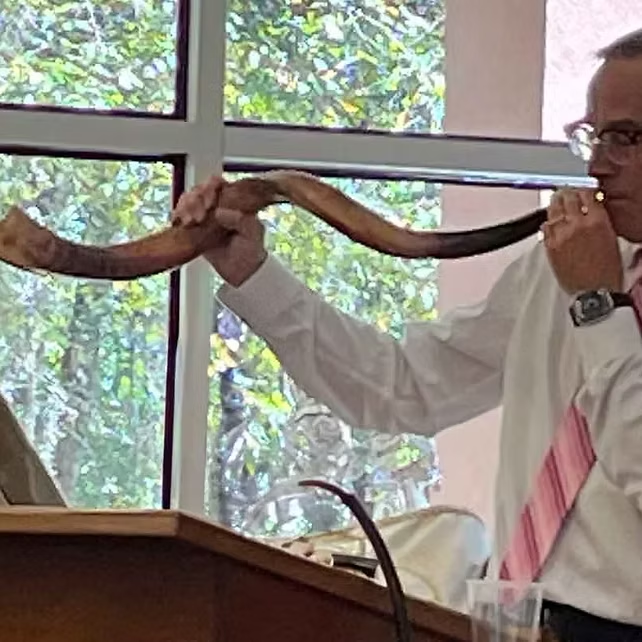
Rabbi Cy Stanway
Shir Shalom – Gainesville
July 11, 2025
There is an old saying that what makes God laugh is seeing our plans for the future or, as John Lennon once said, ‘Life is what happens while you are making other plans.’ It might be more accurate to say, rather, that what makes God really laugh is our self-delusion, especially our delusions of grandeur and just how wonderful and god-like we are.
The Torah has some well-known examples of how we like to see ourselves as deities. The Tower of Babel, which the text tells us extended its top to heaven is quite possiblly the most famous. Here humanity got together and, having already mastered building techniques, thought itself as equals with the other Builder; namely God.
The idea was that tall buildings – man-made mountains – allowed humans to climb to the dwelling place of the gods and then, being literally on the same level as the gods, be able to communicate with them. There are lots of other examples that reflect the same mind-set: the Pyramids of Egypt, the temples built by the Mayans and the Azteks and almost any ritual or religious structure built atop a mountain. It was the builders’ way of representing equality with God.
And in the case of the Tower of Babel, what does the text say after it was already pretty high? “And the Lord came down to see the city and the tower, which the children of man had built.” This is God laughing. To quote a rabbinic commentator, “On earth, humans thought they had reached the sky, but to God the building was so infinitesimal, so microscopic that he had to come down even to see it. Only with the invention of flight do we now know how small the tallest building looks when you are looking down from a mere 30,000 feet.”
There are other examples of this kind of hubris at which God laughs. There’s Pharoah from the Moses and the Exodus story. We hear the Divine laughter especially in the third plague: lice. For the first time, the magicians tried and failed to replicate the effect. Defeated, they turned to Pharaoh and said, “It is the finger of God.” Step back and look at the humour here. The Egyptians built the cities of Pithom and Raamses and, of course, the pyramids. They were symbols of the divine Pharaoh’s power. And yet, how did God humble Pharoah? With the smallest insect. Pharoah’s hubris, power and self-delusion crumbles because of a gnat!
The Torah is teaching the lesson. When people think they are big, God shows them they are small – and vice versa. It is those who think themselves small – supremely so Moses, the humblest of men – who are truly great. Or King David who was brought down to size after his sins but elevated in stature after his repentance.
So what does all this have to do with this week’s parasha? Well, keep in mind that the people of Moab and Midian thought of Bilam was that of a god. It was also probably the way he thought of himself. Balak the Moabite king, together with the leaders of the Midianites, sent a delegation to Bilam asking him to curse the Israelites: “Come now, curse this people for me, since they are too mighty for me … for I know that whom you bless is blessed, and whom you curse is cursed.”
This is often the way people think of the holy person. She or he is the magic worker and can do everything from change the outcome of a test to change the weather. We still see shades of this even today. I recall that a bar mitzvah parent got angry with me that it rained on her son’s bar mitzvah day. Maybe she was joking. Maybe she wasn’t. But I have learned that in every joke is a grain of truth about the one telling it.
The Torah’s view is precisely the opposite. It is God who blesses and curses, not human beings. “I will bless those who bless you and those who curse you I will curse,” God said to Abraham. “They shall place my name on the children of Israel and I will bless them,” he said about the priests. The idea that you can hire a holy man to curse someone essentially presupposes that God can be bribed.
It is a strange story. God tells Bilam not to go. Balak sends a second delegation with a more tempting offer. This time God tells Bilam to go with them but instructs him to so only what he instructs him to say. The next morning Bilam sets out to go with the Moabites, but the text now states that God was “angry” with him for going. That is when the episode of the donkey takes place.
This is where things getting trippy: The donkey sees an angel barring the way. It turns aside into a field but Bilam hits it and forces it back to the path. The angel is still barring the way and the donkey veers into a wall, crushing Bilam’s foot. Bilam hits it again, but finally it lies down and refuses to move. That is when the donkey begins to speak. Bilam then looks up and sees the angel, who had been invisible to him beforehand.
Why did God first tell Bilam not to go, then that he should go, and then was angry when he went? This is the Torah’s way of saying that God could read his mind and knew that Bilam did really want to curse the Israelites.
But, once again, we have divine humour. A talking donkey is, without doubt the epitome of God laughing. Here was Balaam, hired because of his ability to bless or curse, a man whose business card probably said something like ‘Recommended by kings and despots the world over!” He sold himself well. People really did think he had the power to bless or curse whomever he chose.
It’s not quite the way the story worked out, was it? God, the Torah tells us, is not like that at all. He had two messages, one for the Moabites and Midianites, another for Bilam himself.
He showed the Moabites and Midianites that Israel is not cursed but blessed. The more you attempt to curse them the more they will be blessed and you yourself will be cursed. Every civilization or movement that has tried to curse and crush the Jewish people is gone. And every movement that tries to crush the Jewish people will meet the same fate. Some call it Jewish resilience. The Torah calls it divine intervention with God working in the background. That was the message for the Midianites and the Moabites.
God had a different message for Bilam himself, and it was very blunt. If you think you can control God, then, says God, I will show you that I can turn a donkey into a prophet and a prophet into a donkey. Your animal will see angels to which you yourself are blind. Bilam was forced to admit:
How can I curse those whom God has not cursed?
Hubris always eventually becomes a nemesis. In a world in which rulers engaged in endless projects of self-aggrandisement, Israel alone produced a literature in which they attributed their successes to God and their failures to themselves. The great irony and profoundly spiritual lesson is that, far from making them weak, this made them extraordinarily strong.
Pagan prophets like Bilam had not yet learned the lesson we must all one day learn: that what matters is not that God does what we want, but that we do what He wants. God is not the cosmic vending machine that can be manipulated. There are no magical incantations that summon God to our will. God laughs at those who think they have godlike powers. Rather, the opposite is true. The smaller we see ourselves, the greater we become. It is the opposite the way we customarily see ourselves and others. Rather, let us see ourselves not as great, but simply as good and live each day with that good in every step we take. Then, indeed, will our lives be a blessing.
Shabbat Shalom